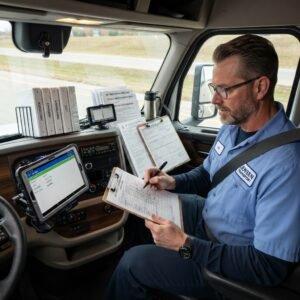
Running your own truck gives you more control over your business.
It also gives you more responsibility.
As an owner-operator, you are not just the person behind the wheel. Depending on how your operation is set up, you may also be responsible for vehicle maintenance, driver records, hours-of-service compliance, drug and alcohol testing, and other carrier requirements.
That can feel like a lot.
The good news is that compliance becomes much easier when you stop treating it like one giant job.
Instead, break it into a few areas and stay on top of them throughout the year.
This owner-operator compliance checklist walks through seven areas you should pay attention to if you operate your own trucking business.
Important: This article is an educational guide, not legal advice. FMCSA requirements can depend on your operation, equipment, cargo, and whether you operate interstate or intrastate. Always verify requirements that apply specifically to your business.
What’s in This Guide
- Keep your truck and trailer maintenance records organized
- Stay on top of your hours-of-service records
- Keep your driver qualification information current
- Understand your Drug & Alcohol Clearinghouse responsibilities
- Stay compliant with DOT drug and alcohol testing
- Keep your registrations, licenses, and insurance information current
- Build a simple system for staying ahead of deadlines
1. Keep Your Truck and Trailer Maintenance Records Organized
Your truck is your business.
If it cannot legally and safely operate, your income can stop with it.
Federal motor carrier rules require carriers to systematically inspect, repair, and maintain vehicles under their control. Required maintenance records include information about the vehicle, scheduled maintenance, and records showing inspections, repairs, and maintenance performed.
That means you should not rely on memory or a pile of receipts in the glove box.
Keep track of things like:
- Preventive maintenance
- Oil and filter changes
- Tire inspections and replacements
- Brake work
- Suspension repairs
- Steering repairs
- Lighting repairs
- Annual inspections
- Major component replacements
- Repair invoices
- Inspection reports
You also need to pay attention to your annual inspection.
Each commercial motor vehicle, including each segment of a combination vehicle, must receive a periodic inspection at least once every 12 months. FMCSA also requires the inspection report to be retained for the required period.
Don’t forget the trailer
One mistake some new owner-operators make is thinking only about the tractor.
Your trailer matters too.
Depending on your operation and who controls the equipment, make sure the required inspection and maintenance responsibilities are clearly understood.
A simple way to stay organized
Create a maintenance folder for every piece of equipment.
For example:
Truck 1
- Annual inspection
- PM records
- Repair invoices
- Tire records
- Brake records
- Roadside inspection reports
- Other important maintenance documents
Digital records can make this much easier.
The goal is simple:
If someone asks for a maintenance record, you should know exactly where to find it.
2. Stay on Top of Your Hours-of-Service Records
Hours of service can become complicated quickly.
You may know the basic rules, but that does not mean your records will always be perfect.
Your ELD or record of duty status needs to accurately reflect your workday.
FMCSA requires motor carriers to retain records of duty status and supporting documents for six months.
Make these habits part of your routine:
- Review your logs regularly.
- Keep your duty-status changes accurate.
- Correct legitimate errors promptly.
- Keep required supporting documents.
- Understand how personal conveyance applies before using it.
- Make sure your ELD information is complete.
- Review unidentified driving time.
- Keep your records available for the required retention period.
Do not wait until you are pulled into an inspection to discover a problem.
Check your logs before you shut down
A quick end-of-day review can catch mistakes while they are still fresh.
Ask yourself:
Did my log accurately show what I actually did today?
If something needs attention, deal with it before the next day gets busy.
Why this matters
Your log is more than paperwork.
It can become important during:
- Roadside inspections
- Safety investigations
- Audits
- Crash investigations
- Compliance reviews
Good recordkeeping gives you a much better picture of your actual operation.
3. Keep Your Driver Qualification Information Current
When you own your truck and operate under your own authority, you may be wearing two hats:
Driver and motor carrier.
That means you cannot think about compliance only from the driver’s side.
You also have carrier responsibilities.
FMCSA’s driver qualification rules require motor carriers to maintain a driver qualification file for each driver they employ. The requirements include various records related to the driver’s qualifications, driving history, medical qualification, and annual review.
For a one-driver operation, that means you still need to understand what applies to you.
Keep an organized driver file
Depending on your operation and applicable requirements, your records may include items such as:
- Driver application
- Motor vehicle records
- Road test documentation or equivalent
- Annual driving record inquiry
- Annual review documentation
- Medical qualification information
- Required certifications
- Other applicable qualification records
The important point is not simply having a folder.
It is keeping that folder current.
Put expiration dates on your calendar
Do not wait for a document to expire before thinking about it.
Track important dates for:
- Medical certification
- CDL
- Endorsements
- Annual MVR checks
- Required reviews
- Other certifications that apply to your operation
A calendar reminder can prevent a small administrative problem from becoming a much bigger one.
4. Understand Your Drug & Alcohol Clearinghouse Responsibilities
The Drug & Alcohol Clearinghouse is another area owner-operators cannot afford to ignore.
If you are an owner-operator who employs yourself as a CDL driver, you can have responsibilities as both the employer and the driver.
FMCSA’s Clearinghouse guidance states that owner-operators must designate a consortium/third-party administrator (C/TPA) for certain Clearinghouse responsibilities. Owner-operators must also conduct required queries, including an annual query for themselves.
Your checklist should include:
- Registering for the Clearinghouse when required
- Designating your C/TPA
- Completing required queries
- Completing the annual query requirement
- Giving required consent
- Understanding reporting responsibilities
- Keeping your Clearinghouse responsibilities on your compliance calendar
An important detail is that using a C/TPA does not completely transfer your responsibility to someone else.
FMCSA states that the employer remains responsible for compliance even when a C/TPA is used.
Don’t assume your C/TPA has everything covered
A service provider can help manage the process.
That does not mean you should stop paying attention.
Know what services you are paying for.
Know what they are responsible for.
And know what you are still responsible for.
5. Stay Compliant With DOT Drug and Alcohol Testing
If you operate a CMV that requires a CDL, DOT drug and alcohol testing requirements can apply to you even when you are a one-person operation.
FMCSA specifically states that owner-operators operating qualifying CMVs are subject to DOT drug and alcohol testing requirements and must participate in a consortium random testing pool when applicable.
For an owner-operator who is not leased to another motor carrier, FMCSA guidance says participation in a consortium for random testing purposes is required.
Your compliance system should account for:
- Pre-employment testing when required
- Random testing
- Post-accident testing when required
- Return-to-duty requirements when applicable
- Required records
- Clearinghouse responsibilities
- Your C/TPA relationship
The exact requirements can depend on your circumstances, so do not assume that being a one-truck operation means the rules do not apply.
Keep your testing records organized
Create a secure location for your drug and alcohol compliance records.
Do not rely on emails scattered across your inbox.
You want to be able to quickly answer:
Where are my records?
Who manages my random testing?
When was my last required action completed?
What is coming due next?
If you cannot answer those questions quickly, your compliance system needs some work.
6. Keep Your Business and Operating Documents Current
Compliance is not only about your ELD and maintenance records.
There are other documents and credentials that can affect your ability to operate.
The exact requirements depend on your business structure and operation, but your compliance calendar should account for applicable items such as:
- CDL and endorsements
- Medical qualification
- Motor carrier registration
- Operating authority
- Insurance filings
- Vehicle registration
- IRP registration
- IFTA requirements
- UCR registration
- State-specific requirements
- Permits
- Lease agreements
- Other credentials required for your operation
Not every owner-operator has the same requirements.
That is why it is important to build your checklist around your actual operation.
Do not wait for a renewal notice
Make your own calendar.
For every important document, record:
What it is → When it expires → How you renew it → Who is responsible
That simple system can prevent a surprising number of headaches.
7. Build a Compliance Calendar You Actually Use
This may be the most useful step of all.
Compliance becomes difficult when everything lives in your head.
You are driving.
Booking loads.
Fueling.
Handling customers.
Managing repairs.
Paying bills.
Looking for freight.
And trying to remember when something needs to be renewed.
That is too much to rely on memory.
Create three simple categories
Monthly
Review things such as:
- Maintenance coming due
- ELD/log issues
- Open repair items
- Important documents
- Upcoming deadlines
Quarterly
Take a deeper look at:
- Maintenance history
- Compliance records
- Drug and alcohol program status
- Vehicle condition
- Business registrations
- Insurance documents
- Outstanding compliance issues
Annually
Review:
- Annual vehicle inspections
- Driver qualification requirements
- MVR requirements
- Clearinghouse annual query
- Medical qualification
- Registrations and renewals
- Insurance
- Permits
- Other operation-specific requirements
You can use a spreadsheet, calendar, compliance app, or another system.
The tool matters less than the habit.
A Simple Owner-Operator Compliance Checklist
Save this list and use it as a starting point for your own system.
Vehicle
- Annual inspection is current
- Maintenance records are organized
- Preventive maintenance schedule is current
- Repair records are saved
- Roadside inspection reports are handled
- Tractor records are organized
- Trailer records are organized
Hours of Service
- ELD is functioning properly
- Logs are accurate
- Supporting documents are handled properly
- Unidentified driving time is reviewed
- Required records are retained
Driver Qualification
- Driver qualification records are organized
- CDL is current
- Required endorsements are current
- Medical qualification is current
- MVR requirements are completed
- Annual review requirements are handled
Drug & Alcohol
- DOT testing program is established
- C/TPA is designated when required
- Random testing requirements are being handled
- Clearinghouse registration is complete when required
- Annual Clearinghouse query is completed when required
- Required records are organized
Business
- Operating authority is current
- Insurance is current
- Vehicle registration is current
- IRP requirements are handled
- IFTA requirements are handled
- UCR requirements are handled
- Required permits are current
- State-specific requirements are reviewed
The Best Compliance System Is the One You Actually Use
You do not need a complicated system to stay organized.
You need a system that tells you three things:
What needs to be done?
When does it need to be done?
Where is the documentation?
That is the foundation of good owner-operator compliance.
Set up your folders.
Create your calendar.
Add your expiration dates.
Review your records regularly.
And when you are unsure about a requirement, verify it with the appropriate FMCSA guidance or a qualified compliance professional rather than guessing.
The goal is not to spend your entire week thinking about regulations.
The goal is to build a system that keeps compliance from becoming a surprise.
Final Takeaway
Being your own boss does not mean you have to manage everything from memory.
A good owner-operator compliance system can help you stay organized, catch deadlines before they become problems, and keep important records ready when you need them.
Start with the basics:
Maintain the equipment.
Track your hours.
Keep your driver records current.
Stay on top of Clearinghouse and testing requirements.
Track your business credentials.
And review your compliance calendar regularly.
A little organization now can save you a lot of trouble later.
Want to make this easier? Start by creating one master compliance folder and one calendar for every recurring requirement in your trucking business.