Buying vs. Leasing a Semi Truck: Which Is Better for Owner-Operators?
Last updated: September 11, 2026
Over a five-year period, the true financial cost between buying and leasing the exact same $150,000 truck can swing your bottom line by more than $21,000, and leave you with either a valuable asset or an empty driveway. For an owner-operator, choosing whether to buy or lease your equipment is the single most impactful business decision you will make.
Quick Answer: Buying a semi truck is better for owner-operators who have cash for a down payment, want to build long-term equity, and plan to keep the equipment for several years. Leasing is better for drivers who need to preserve upfront cash, want to drive newer equipment, and prefer predictable, shorter-term commitments without the risk of heavy depreciation.
Key Takeaways:
- Total cost matters most: A lower monthly lease payment often results in a higher total cost over a five-year term compared to purchasing.
- Equity is leverage: Buying builds ownership. When the loan is paid off, you hold an asset you can sell, trade, or run payment-free.
- Leasing protects cash flow: Traditional leasing requires a smaller initial investment, keeping your cash reserves free for emergencies or operating expenses.
- Beware of carrier lease-purchases: Many lease-purchase programs tie you to a single carrier and heavily favor the company, making it difficult to ever own the truck.
- Maintenance liability varies: Owning means you pay for all repairs. Leasing sometimes includes warranty coverage, but you may still be on the hook for routine maintenance.
Buying vs. Leasing a Semi Truck at a Glance
Comparing buying vs leasing a semi truck comes down to weighing upfront costs against long-term equity. Buying requires more cash today but rewards you with an asset tomorrow. Leasing keeps cash in your pocket now but leaves you empty-handed when the contract ends.
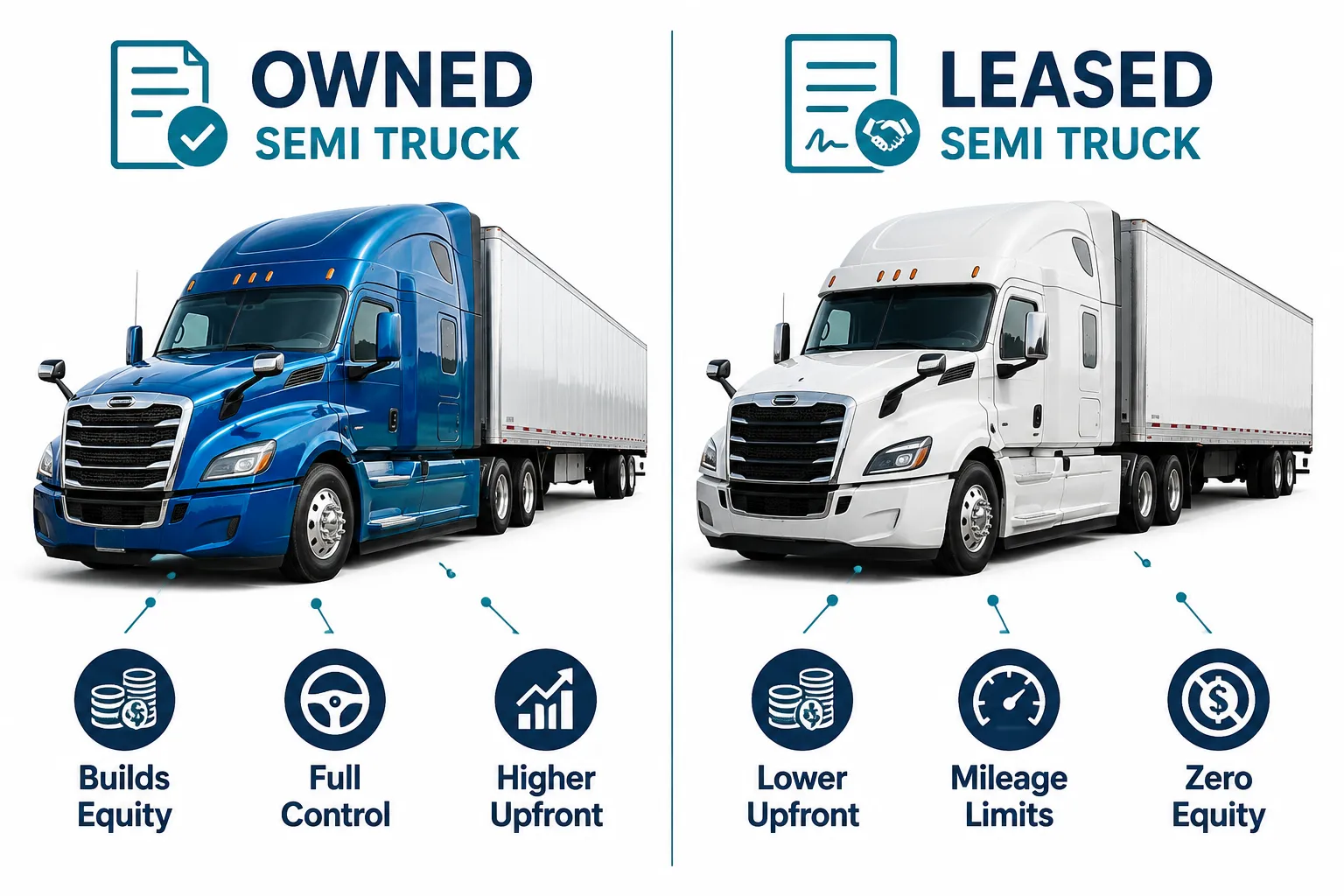
To make an informed choice, you need to look past the monthly payment. Here is how the two paths compare across standard business metrics:
| Feature | Buying a Semi Truck | Leasing a Semi Truck |
|---|---|---|
| Upfront Cost | High (10% to 20% down payment) | Low (First month + security deposit) |
| Monthly Payment | Generally higher | Generally lower |
| Ownership/Equity | Yes (You own it after payoff) | No (Unless it is a specific lease-purchase) |
| Maintenance | 100% your responsibility | Varies (often your responsibility, but under warranty) |
| Mileage Limits | None (Run as much as you want) | Often capped (Penalties for overages) |
| Flexibility | High (Modify or sell anytime) | Low (Strict contract terms) |
What Does It Mean to Buy a Semi Truck?
Buying a semi truck means you are purchasing the equipment outright, either with cash or through a commercial loan. You hold the title (or the bank holds it until the loan is satisfied), and every payment you make builds your ownership stake in the vehicle.
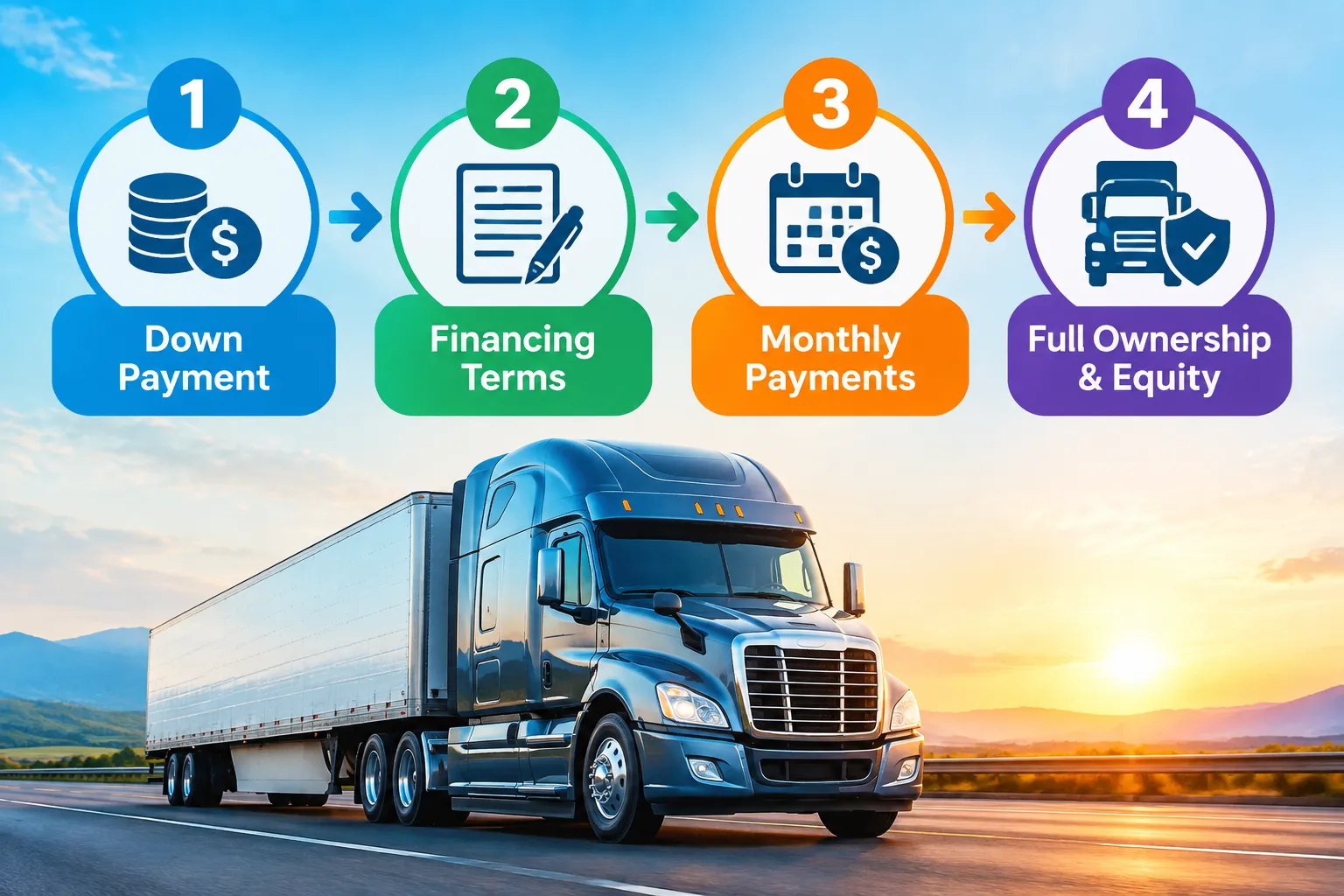
When you finance a truck in 2026, you typically need a down payment of 10% to 20%. You will sign a loan agreement, usually spanning 48 to 72 months, and pay a set interest rate based on your credit score and business history.
Because you own the truck, you have complete operational freedom. You can modify the engine, add custom accessories, or paint it however you like. You also have no mileage restrictions, meaning you can run as hard as the law allows. Once the final payment clears, the truck is yours. You can continue running it without a monthly payment, dramatically increasing your profit margin, or you can sell it to fund your next down payment.
What Does It Mean to Lease a Semi Truck?
Leasing a truck means you are renting the equipment for a specific period, usually 36 to 60 months. You do not own the truck, and unless you have a specific buyout clause, you must return it at the end of the term.
There are two primary types of leases in the trucking industry. A traditional equipment lease (often called an operating lease) is obtained through a dealership or commercial lender. You pay a monthly fee to use the truck, and at the end of the term, you walk away or start a new lease with a newer truck.
The second type is a carrier lease-purchase program. In this scenario, a trucking company leases the equipment directly to you. While these programs promise eventual ownership, they are notoriously risky. If you leave the carrier, you usually lose the truck and all the money you invested. According to industry data on truck financing, drivers must carefully review the math on these carrier programs, as many are designed to keep the driver in debt rather than build true ownership.
Advantages of Buying a Semi Truck
The biggest advantage of buying a truck is that you are building wealth for your business rather than paying for someone else’s asset. Every payment moves you closer to full ownership.
- You build equity: A well-maintained truck holds significant resale value. When you decide to upgrade, you can trade it in or sell it outright.
- No payments after payoff: Once the loan is clear, your monthly overhead drops drastically. This allows you to weather slow freight markets much easier than a driver locked into a lease.
- Total operational control: You dictate how the truck is maintained, where it is serviced, and how many miles it runs. There are no mileage penalties.
- Tax benefits: Owners can take advantage of depreciation deductions (like Section 179) and deduct the interest paid on the commercial loan.
Disadvantages of Buying a Semi Truck
The primary barrier to buying a truck is the heavy capital requirement. It ties up a significant amount of your business cash flow in a depreciating asset.
- Large upfront investment: A $150,000 truck requires a $15,000 to $30,000 down payment. This can drain your emergency maintenance fund.
- Total maintenance liability: When the warranty expires, every blown turbo, transmission failure, and tire replacement comes directly out of your pocket.
- Depreciation risk: Trucks lose value rapidly in their first few years. If the used equipment market crashes, you could find yourself “upside down” on your loan, owing more than the truck is worth.
- Harder to upgrade: If you want a newer truck with better fuel efficiency, you have to go through the process of selling or trading in your current equipment.
Advantages of Leasing a Semi Truck
Leasing appeals to owner-operators who want to run their business with predictable expenses and minimal upfront cash requirements. It is a cash-flow management tool.
- Preserves working capital: Instead of dropping $20,000 on a down payment, you might only need the first month’s payment and a security deposit. You can use your cash for fuel, insurance, and emergencies.
- Access to newer equipment: Leasing allows you to drive a late-model truck with the latest safety features and fuel efficiency.
- Warranty protection: Because leased trucks are usually newer, they often remain under the manufacturer’s warranty for the duration of the lease, protecting you from catastrophic repair bills.
- Easy upgrades: At the end of a three-year lease, you simply hand the keys back and sign a new lease for a brand-new truck.
Disadvantages of Leasing a Semi Truck
The convenience of leasing comes at a steep price. Over the long haul, leasing is almost always the more expensive way to operate a trucking business.
- Zero equity: You can make $100,000 in lease payments over three years and own absolutely nothing when the contract ends.
- Higher total cost: While the monthly payment looks lower, the math heavily favors buying over time.
- Mileage restrictions: Most leases cap your annual mileage (e.g., 120,000 miles per year). If you run hard and exceed the limit, you will pay hefty per-mile penalties at the end of the term.
- Strict condition requirements: You must return the truck in excellent condition. The leasing company will charge you for any abnormal wear and tear, cosmetic damage, or missed maintenance intervals.
- Carrier dependence: If you are in a carrier lease-purchase, your success is entirely tied to the company’s freight volume. If they stop dispatching you good loads, you cannot make the payment, and they repossess the truck.
Buying vs. Leasing: Which Costs Less?
When looking at the bottom line, buying is cheaper than leasing over a five-year timeline. To understand why, you have to calculate the total cost of ownership, which includes the resale value of the truck.
Consider a standard scenario from a comprehensive lease vs buy financial breakdown. If you finance a $150,000 truck at an 8% interest rate with a 15% down payment, your out-of-pocket costs (down payment plus monthly payments) will be high. However, after five years, you own a truck that you can sell for roughly $40,000 to $60,000. Factoring in that resale value, the true cost of buying drops to approximately $146,780.
In contrast, leasing the exact same truck at $2,800 per month for five years costs over $168,000. At the end of those 60 months, you have to give the truck back. You have spent $21,000 more and have zero equity to show for it. Always run a five-year projection before signing any paperwork.
Truck True Cost Calculator
Estimate your 5-year total cost based on the industry standard 15% down payment and 40% retained resale value.
When Buying a Semi Truck Makes More Sense
Purchasing is the traditional route to long-term profitability in the trucking industry. Choose to buy your semi truck if your primary goal is building lasting business assets.
- You plan to keep the truck for 5+ years: The longer you keep the truck after paying it off, the higher your profit margins climb.
- You have strong cash reserves: You can comfortably afford a 15% to 20% down payment without depleting your emergency maintenance fund.
- You want maximum operational freedom: You need to run high mileage without worrying about end-of-lease penalties or strict wear-and-tear guidelines.
- Your revenue is predictable: You have established direct customer freight or run for a stable carrier, ensuring you can meet a fixed monthly loan payment regardless of market dips.
When Leasing a Semi Truck May Make More Sense
Leasing is a strategic choice for specific financial situations. Choose to lease your semi truck if preserving upfront cash is more important than building long-term equity.
- You want to protect working capital: You would rather keep your $25,000 in the bank for operating expenses than hand it to a dealership as a down payment.
- You demand maximum uptime: You prefer trading in for a new truck every three years to avoid major out-of-pocket breakdowns and keep the truck under factory warranty.
- You are testing the waters: If you are a first-time owner-operator, a short-term lease allows you to test running your own business without taking on a massive loan liability.
- The lease terms are exceptional: Occasionally, dealerships offer subsidized lease rates to move inventory. If you run the total cost calculations and the lease math actually beats financing, it becomes a viable business move.
Questions to Ask Before Buying or Leasing
Never sign a truck contract based solely on the monthly payment. Whether you are at a dealership or talking to a carrier’s recruiting department, demand clear answers to these questions:
- What is the total cost over the entire term? Multiply the monthly payment by the term length and add the down payment. Look at the real number.
- What is the effective interest rate? Leases do not always state an APR. Ask for the “money factor” or calculate the effective interest rate yourself.
- Who pays for maintenance? Does the lease include a maintenance escrow account? If you buy, is there an extended warranty available?
- What are the mileage limits? If leasing, ask exactly how much you will be charged per mile if you go over the limit.
- What happens at the end of the agreement? Can you buy the leased truck? What is the balloon payment? If you financed, when do you physically receive the title?
- What happens if I want out early? Ask to see the early termination clause. Breaking a lease or a loan early usually results in severe financial penalties.
A Simple Way to Decide
Making the decision between buying vs leasing a semi truck requires running your own numbers. Do not rely on dealership estimates or carrier promises. Follow this simple process:
- Estimate realistic revenue: Calculate your expected monthly gross income based on current 2026 freight rates, not boom-market highs.
- Calculate operating expenses: Subtract fuel, insurance, tolls, and taxes.
- Compare the payments: Look at the monthly loan payment versus the lease payment.
- Factor in maintenance: Add a dedicated maintenance savings line to your budget (usually 10 to 15 cents per mile).
- Project the 5-year outcome: Calculate the total cash out of pocket for both options over 60 months. Then, subtract the estimated resale value of the purchased truck.
Make your decision based on which scenario leaves your business with the strongest balance sheet at the end of the term, not just which one is easier to afford today.
Buying vs. Leasing a Semi Truck: Frequently Asked Questions
Is it better to buy or lease a semi truck?
Buying is generally better for long-term wealth and equity building, while leasing is better for preserving upfront cash and driving newer equipment. The right choice depends entirely on your cash reserves and business goals.
Is leasing a semi truck cheaper than buying?
Leasing usually offers a lower upfront cost and sometimes a lower monthly payment, but it is almost always more expensive over the long term. Because you build zero equity, the total financial cost of leasing is higher than buying.
Can you make more money with a leased truck?
You can generate the same gross revenue with a leased truck as an owned truck, but your net profit will likely be lower over time. However, a leased truck under warranty may experience less downtime, allowing you to run more consistent miles.
Do owner-operators usually buy or lease their trucks?
Experienced owner-operators heavily favor buying because they understand the value of equity. First-time owner-operators often start with leases to minimize their initial financial risk before eventually buying their own equipment.
What should I look for in a truck lease?
Look closely at the mileage limits, wear-and-tear penalties, and the walk-away terms. Avoid carrier lease-purchase programs that restrict you from taking the truck to a different company if the freight dries up.
How long should an owner-operator keep a truck?
Many successful owner-operators keep a purchased truck for 5 to 7 years. This allows them to pay off the loan in 4 years and enjoy 1 to 3 years of maximum profitability without a truck payment before maintenance costs begin to outweigh the benefits.
Conclusion
Deciding between buying vs leasing a semi truck is not about finding a universal right answer; it is about finding the right strategy for your current financial reality.
Buying a truck is an investment in your future. It requires discipline, cash reserves, and a willingness to shoulder the burden of maintenance. In return, it offers equity, freedom, and the potential for massive profit margins once the title is in your hand. Leasing is a tool for cash flow management. It allows you to get on the road with less capital and keeps you in newer, reliable equipment, but it requires you to accept that you are paying for a service rather than building an asset.
Before you sign your name on a 60-month contract, run the numbers. Calculate the total cost of ownership, read every line of the maintenance requirements, and understand exactly what happens at the end of the term. Your truck is your business, make sure you are financing it in a way that sets you up for long-term success on the road.
Meta Title: Buying vs. Leasing a Semi Truck: Which Is Best?
Meta Description: Compare the true costs of buying vs leasing a semi truck. Learn how to calculate total ownership costs, protect your cash flow, and build long-term business equity.
Tags: buying vs leasing a semi truck, owner-operator financing, truck lease purchase, semi truck equity, trucking business planning, commercial truck loan, freight market strategy, truck maintenance costs